
Romuald Pliquet
Butterfly
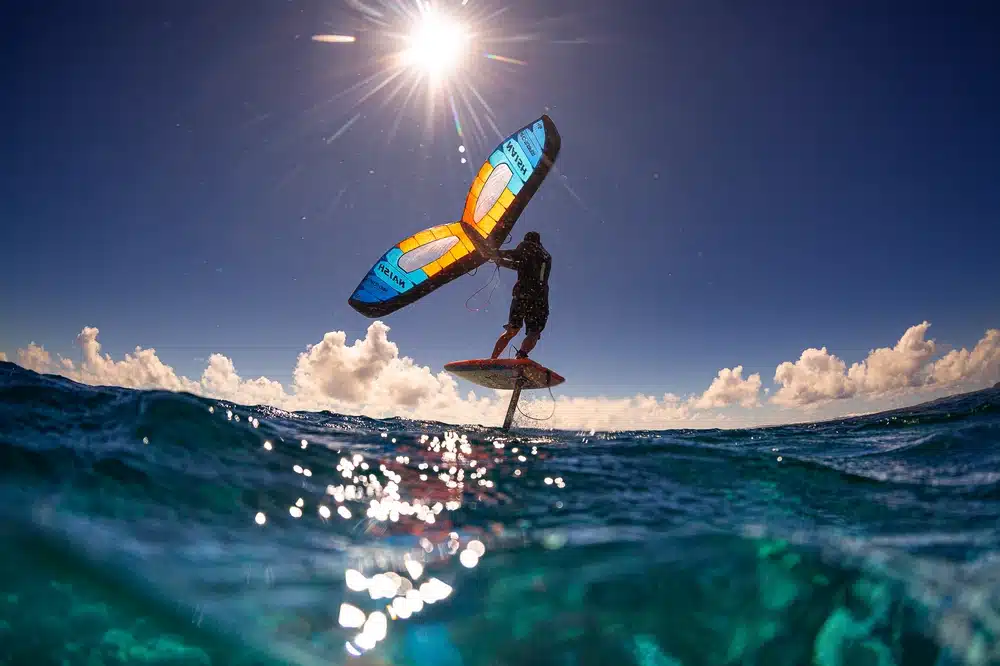
The history of wingfoiling dates back to 1982, when inventor Roland Le Bail filed a patent for a “bird sail”—a wing with characteristics identical to those of a modern wing. In 1986, Tom Magruder introduced the “Wind Weapon,” a free-rotating sail firmly attached to a surfboard via a half-mast. In the years that followed, the technology was adapted and appeared on the market in various versions and under new names. Wing-based sports are not limited to the water; they are also practiced in winter sports on snow, as well as on beaches and land. “Skate Sails,” “Wind Skates,” and “Kitewings” stand out as key milestones in this evolution. Most of these variants share a common feature: a rigid frame used to tension the wing, which also serves as a handlebar or grip system.
The reason for the only moderate success of these early developments was physical: friction. Wings large enough to propel a heavy, slow-moving surfboard—along with the rider’s weight—had to be massive, bulky, and heavy. Wingsurfing only experienced a renaissance with the advent of foil surfing, driven by the kite brand Slingshot’s idea to adapt the kitesurfing wing concept—specifically, an inflatable, compact, lightweight, and affordable wind wing—for wingsurfing. This setup provides sufficient propulsion, especially when paired with foil boards. This technique also won over American surfing icon Robby Naish and well-known manufacturers, who went on to develop inflatable wings for the summer of 2019. The sport is considered more accessible and less dangerous than windsurfing or kitesurfing—while offering similar thrills—and has consequently seen exponential growth among board sports enthusiasts.
Price range: 60,00 € through 1.150,00 €